A mushroom that smells like maple syrup. Sounds impossible, until you hold one in your hand.
Please Note: This is an informational article and not intended for identification. Use a qualified identification book and an expert resource when identifying edible mushrooms.
Every winter, when the rains arrive on the Mendocino Coast, something remarkable happens in the coastal forests. While most tourists stay home and most outdoor businesses shutter for the season, the forest floor comes alive with one of the most unusual edible mushrooms on Earth: the candy cap.
This small, unassuming mushroom (burnt orange, fragile-stemmed, easy to overlook) carries a secret that has captivated foragers, chefs, and scientists for decades. When dried, it releases an aroma so powerfully reminiscent of maple syrup that it has been used to flavor ice cream, cookies, crème brûlée, and caramel sauce. It is, as far as anyone knows, the only wild mushroom in the world that belongs in dessert.
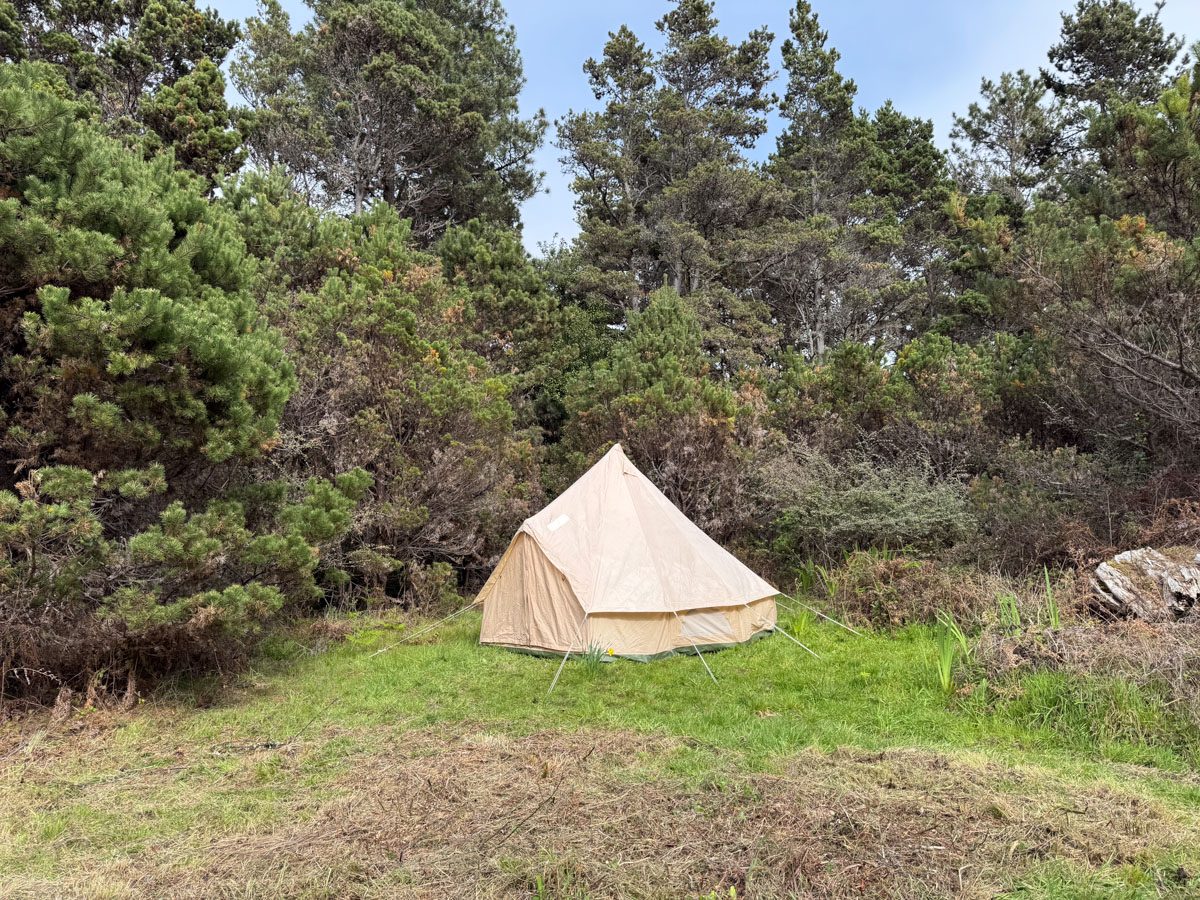
Camp Candy Cap, our nature education center in Fort Bragg, is named for this extraordinary fungus. And if you’ve never heard of it before, you’re about to understand why people drive hours through winter storms to find it.
What Exactly Is a Candy Cap?
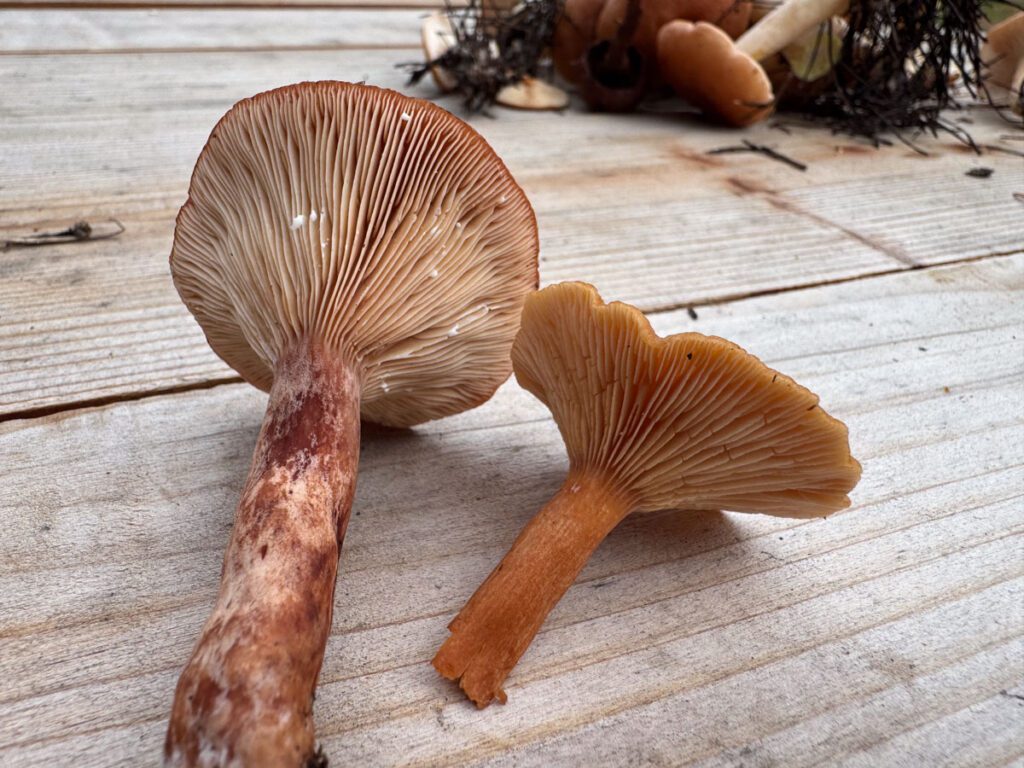
The candy cap most commonly found on the Mendocino Coast is Lactarius rubidus, a member of the milkcap family. Like all Lactarius species, it bleeds a thin, milky latex when its flesh is cut or broken: in the candy cap’s case, a pale, watery fluid that resembles skim milk.
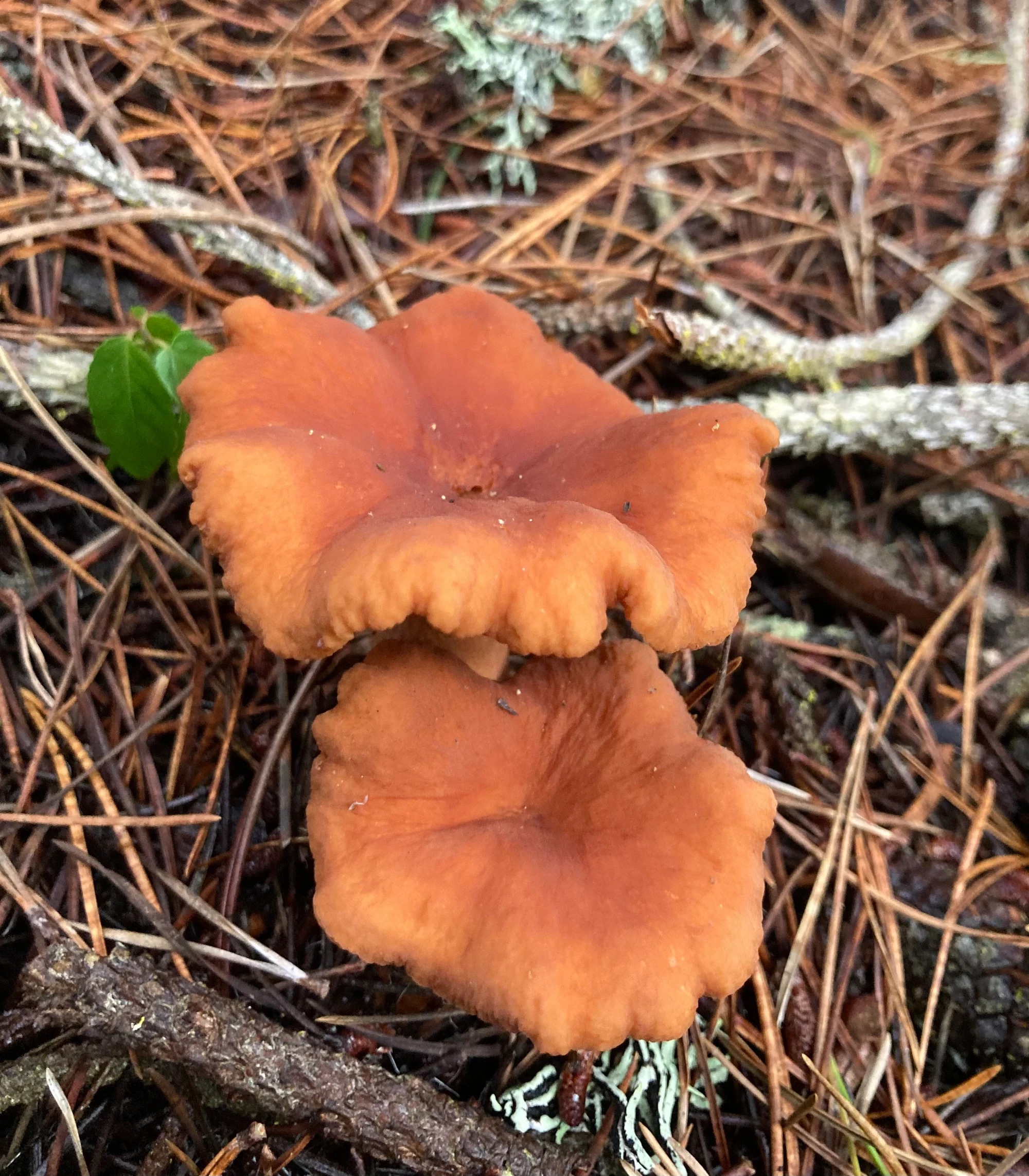
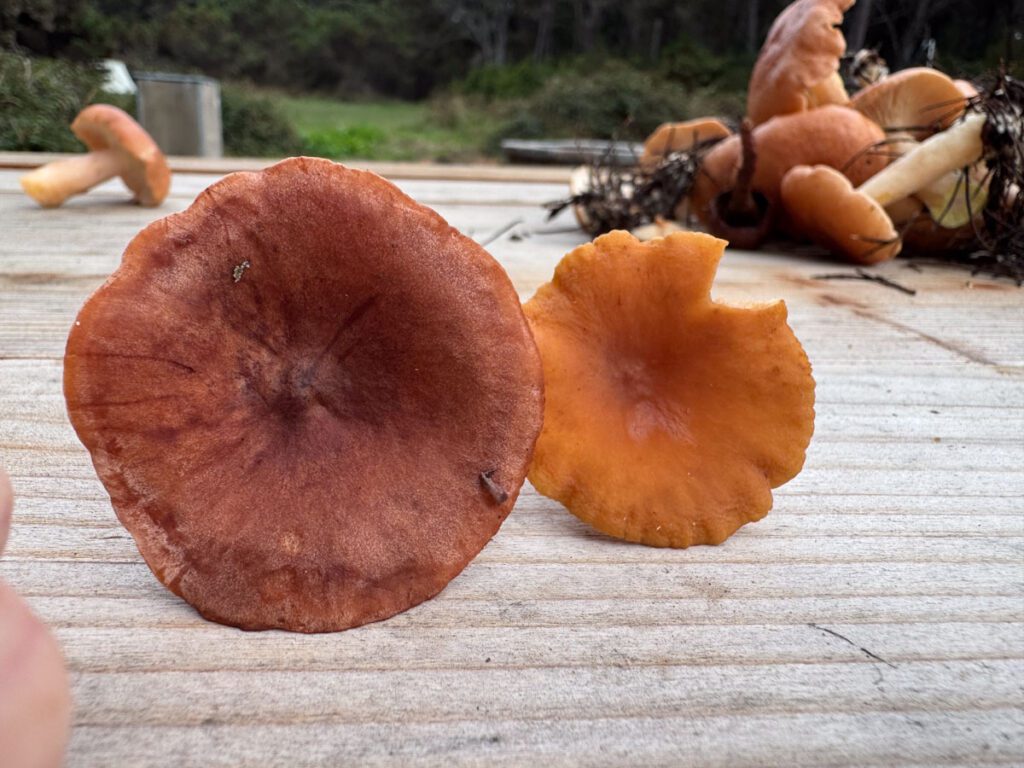
Fresh candy caps don’t look like much. They’re small, typically less than five centimeters across the cap, with a cinnamon to burnt-orange color that darkens toward the center. The cap starts convex and flattens with age, often developing a slight central dimple and wavy margins. The stem is slender and fragile. Snap it and it breaks cleanly, like chalk. This brittleness is actually a useful identification feature shared by all members of the Lactarius and Russula families, caused by specialized round cells called sphaerocysts in their tissue.
But the real magic of the candy cap isn’t visible. It’s molecular.
The Chemistry of Maple Syrup in a Mushroom
For 27 years, chemical ecologist William Wood of Humboldt State University tried to identify the compound responsible for the candy cap’s extraordinary aroma. The mystery was finally solved in 2012 when Wood and his team isolated the culprit: a compound called quabalactone III, an aromatic lactone present in the fresh tissue and latex of Lactarius rubidus.
Here’s where it gets interesting. Quabalactone III itself isn’t especially fragrant. But when the mushroom dries, the compound undergoes hydrolysis (a chemical reaction with water) and transforms into sotolon. And sotolon is one of the most powerful aroma molecules known to food science.
Sotolon is the primary flavor compound in fenugreek seed. It’s present in molasses, aged rum, roast tobacco, and flor sherry. At lower concentrations, it smells unmistakably like maple syrup and caramel. At higher concentrations, it shifts toward curry and fenugreek. It is, in fact, the key ingredient in most artificial maple syrup flavoring.
This is the same molecule that was responsible for the infamous “mystery maple syrup smell” that periodically wafted across Manhattan starting in 2005. (The source turned out to be a fenugreek processing plant across the river in New Jersey.)
In the candy cap mushroom, the sotolon is so potent that dried specimens have been documented retaining their aroma for over 60 years in herbarium storage. Handle dried candy caps and your hands will smell like maple syrup for the rest of the day. Heat them in cream and your entire kitchen, your entire house, will fill with the scent.
The detection threshold for sotolon is astonishingly low: 0.010 nanograms per liter of air. That’s why a few grams of dried candy cap can flavor an entire batch of ice cream.
Where and When to Find Them
Candy caps fruit along the West Coast of North America, from Washington through Oregon and into California. But their heartland is Northern California’s coastal forests, and the Mendocino Coast sits right in the sweet spot.
Lactarius rubidus is mycorrhizal, meaning it forms a mutualistic partnership with the roots of living trees. The fungus wraps around the tree’s root tips in a structure called an ectomycorrhiza, helping the tree absorb water and nutrients from the soil while receiving sugars from the tree’s photosynthesis in return. On the Mendocino Coast, candy caps associate primarily with conifers (Douglas fir, pine, and spruce), though they also appear under tanoak and live oak.
Unusually for a mycorrhizal species, Lactarius rubidus is also commonly found growing directly on decaying conifer wood. This dual habitat, both soil and rotting wood, makes the candy cap somewhat easier to find than many other mycorrhizal mushrooms, though “easy” is relative. They’re small, they blend in with the forest duff, and they require hours of stooping and careful looking.
The season runs roughly from late November through March on the Mendocino Coast, triggered by the arrival of sustained winter rains. November, December, and January tend to be the peak months. This timing is important: candy cap season coincides almost exactly with the period when coastal tourism traditionally drops to its lowest levels. While summer visitors pack the beaches and headland trails, the winter forest offers a completely different, and arguably richer, experience for those willing to get a little wet.
Why You Shouldn’t Forage Alone (At Least Not at First)
Here’s the part where we need to be direct: candy caps are small, brownish-orange mushrooms that grow in the same habitat as dozens of other small, brownish-orange mushrooms. Some of those lookalikes are merely unpleasant. Others are dangerous. One (Galerina marginata, the deadly galerina) is lethal.
The good news is that candy caps have a combination of features that, taken together, make positive identification quite reliable for someone with proper training. But each individual feature on its own is insufficient.
Key identification features of Lactarius rubidus:
The mushroom must bleed pale, watery, milk-like latex when the flesh is cut. This latex should not change color when exposed to air. (Beware Lactarius xanthogalactus, a common lookalike in Northern California whose latex turns yellow quickly; this species is considered poisonous.) The stem should snap cleanly, like chalk, rather than bending or tearing fibrous. The cap surface should feel slightly bumpy or nubbly when you run a finger across it, not smooth, not slimy. A useful field trick: briefly singe the flesh with a match or lighter. Candy caps will release a sweet, maple-like aroma under heat even when fresh specimens lack a noticeable smell. The taste of the flesh and latex should be mild to slightly sweet, with absolutely no bitterness or acridity. (Note that some toxic lookalikes have a subtle bitterness that may take a minute to develop, so chew a tiny piece and wait.)
Finally, the spore print should be white to pale yellow. Galerina marginata, the deadly lookalike, produces a rusty brown spore print, one of the most important distinguishing features.
This is why we believe so strongly in guided foraging education. A few hours with an experienced instructor teaches you to see the forest differently, to read the trees, the soil, the moisture, the elevation, and to develop the kind of pattern recognition that keeps you safe and makes you successful. Our mushroom foraging programs pair you with local experts who have been walking these forests for years.
Cooking with Candy Caps: The Dessert Mushroom
Candy caps are not eaten the way you’d eat a chanterelle or a porcini. They’re used more like a spice. Think vanilla, saffron, or truffle. And because the aroma intensifies dramatically with drying, they’re almost always used in dried form.
There are three primary methods for getting candy cap flavor into food:
Infusing in dairy. This is the method most pastry chefs prefer. Crumble dried candy caps into warm cream or milk, let them steep until the liquid is deeply fragrant, then strain. The fat in the dairy dissolves the flavor compounds beautifully. The infused cream can then be used as the base for ice cream, panna cotta, custard, ganache, or any cream-based dessert. This is probably the most forgiving technique for beginners. It’s hard to over-extract, and the results are immediately impressive.
Grinding to powder. Dried candy caps can be ground in a coffee grinder or spice mill to produce a fine powder that can be added directly to cookie dough, cake batter, pie filling, or spice rubs. A little goes a very long way: two to four grams can flavor an entire batch of ice cream. Fair warning: your grinder will smell like maple syrup for weeks afterward, which most people consider a feature rather than a bug.
Making candy cap sugar. Layer dried candy caps with granulated sugar in a sealed jar, shake daily, and wait a week or two. The mushrooms will perfume the sugar with their aroma. Strain out the mushrooms and use the sugar anywhere you’d normally use plain sugar: in shortbread, crème brûlée, caramel sauce, or stirred into coffee. The flavor pairs especially well with brown butter, toasted nuts, chocolate, and bourbon.
Classic candy cap preparations include ice cream (the single most popular use), cookies, bread pudding, panna cotta, and caramel sauce. But adventurous cooks have also used them in savory applications, anywhere maple syrup would traditionally appear. Think candy cap-glazed pork, candy cap vinaigrette, or candy cap-infused bourbon.
Commercially, dried candy caps can sell for upwards of $200 per pound, making them one of the most valuable wild mushrooms in North America. But a little goes so far that even a small amount foraged on a guided walk provides enough for multiple desserts.
The Ecology Beneath Your Feet
When you learn about candy caps, you’re really learning about the invisible infrastructure that holds a forest together.
The mycorrhizal network that candy caps participate in is sometimes called the “wood wide web”, a vast underground system of fungal filaments connecting tree roots across the forest floor. Through this network, trees share nutrients, send chemical warning signals about pest attacks, and support struggling neighbors. The fruiting body you see on the surface, the mushroom, is just the reproductive structure. The real organism is a sprawling network of threadlike hyphae woven through the soil and into the roots of multiple trees.
When you find a patch of candy caps, you’re looking at a visible sign of this hidden partnership. The mushroom is, in a very real sense, the fruit of a relationship between fungus and forest that may be decades old. Understanding this changes the way you move through the woods. You stop seeing trees as isolated individuals and start seeing the forest as a connected, communicating community.
This is what we teach at Camp Candy Cap: not just identification, but ecology. Not just “what can I eat” but “how does this forest work, and what’s my role in it?”
A Winter Reason to Visit the Coast
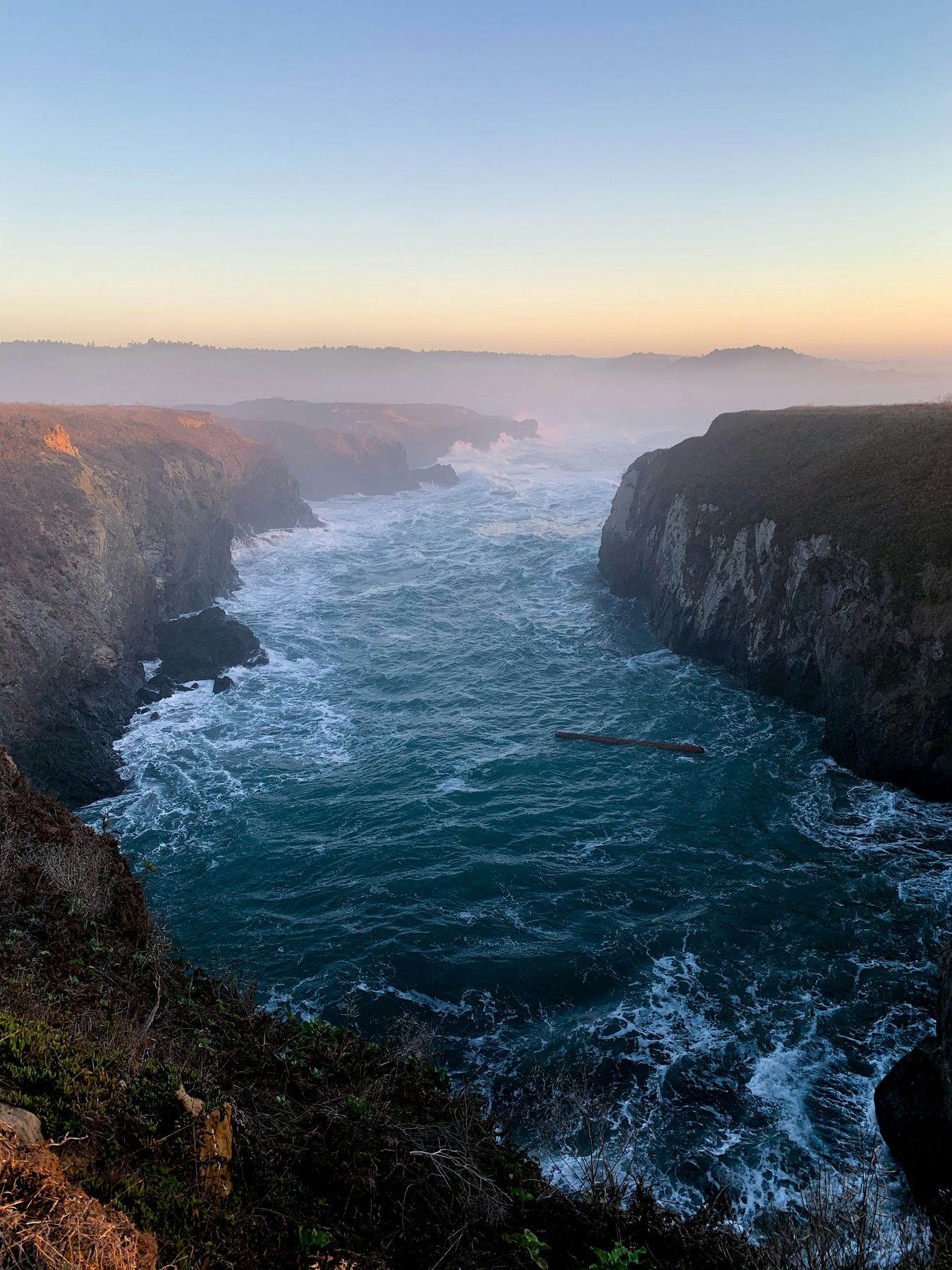
The Mendocino Coast in winter is a different world from the summer version. The light is different, soft and silvered. The ocean is dramatic, with storm swells and whale spouts visible from the headlands. The forests are impossibly green, saturated with rain, draped in moss and fern and lichen. And the air smells like wet earth and wood and the faint sweetness of decay that signals the mycelium doing its work underground.
For most of the outdoor tourism industry, winter is the off-season. For mushroom foraging, it’s prime time. The Mendocino Coast hosts over 3,000 species of fungi, of which roughly 500 are edible. Chanterelles, hedgehogs, porcini, black trumpets, and of course candy caps all fruit in the wet months. November through February is when the coast’s forests are at their most productive and most magical.
This is the season that inspired the name Camp Candy Cap, and the season we think offers the most rewarding experiences for visitors willing to trade beach weather for rain gear and a basket.
Learn to Forage the Right Way
Camp Candy Cap offers guided mushroom foraging programs throughout the wet season, led by local experts who know these forests intimately. You’ll learn not just identification but ecology: the relationships between fungi and trees, the role of moisture and microclimate, the ethics of sustainable harvesting, and how to read the landscape to find productive ground.
Programs range from half-day introductory walks to multi-day intensives that include overnight camping in the coastal forest, evening campfire cooking with your finds, and deep dives into preservation techniques like drying, tincturing, and making infused oils.
All programs are open to the public, no prior experience needed. We also offer reduced rates for schools and nonprofit organizations, because we believe everyone deserves access to this knowledge.
Camp Candy Cap is located on a large plot of coastal forest in Fort Bragg, California. The property is managed for minimal footprint and a commitment to preserving the native character of the land.
To learn more about upcoming programs, visit practical-intelligence.org.
Camp Candy Cap is a nature education camp. We offer hands-on educational programming in coastal ecology, traditional skills, and nature connection on the Mendocino Coast.